Long before the safari jeeps, Tanzania was a crossroads of history. Early humans left footprints in volcanic ash at Laetoli, rock artists painted the shelters of Kondoa, Swahili merchants grew rich in Kilwa, and Zanzibar’s Stone Town became a meeting point of Africa, Arabia and India. Add the Serengeti migration and the snows of Kilimanjaro, and it is no surprise that Tanzania has seven UNESCO World Heritage Sites: three natural, three cultural and one mixed site.
Free Consultation: Tell our local team which UNESCO sites you would like to see and get a free, no-obligation trip plan.
The travel experts from TanzaniaAssist arrange safari drivers, guides, park permits, transfers and lodges for every site on this list. Below you will find the complete list as it stands on the official UNESCO World Heritage List, with the year each site was inscribed, its type, and practical visit information: where it is, how to get there, the best season and how much time to plan. A summary table, the sites on Tanzania’s Tentative List and answers to common questions follow.
How we counted: this list follows the official UNESCO page for the United Republic of Tanzania (whc.unesco.org), which lists seven properties. Kilwa Kisiwani and Songo Mnara are inscribed together as one site.
🗺️ UNESCO World Heritage Sites in Tanzania
- Ngorongoro Conservation Area, mixed, 1979 / 2010
- Ruins of Kilwa Kisiwani and Ruins of Songo Mnara, cultural, 1981
- Serengeti National Park, natural, 1981
- Selous Game Reserve, natural, 1982
- Kilimanjaro National Park, natural, 1987
- Stone Town of Zanzibar, cultural, 2000
- Kondoa Rock-Art Sites, cultural, 2006
The crater, the great migration and Africa’s highest mountain, easy to combine from Arusha and Moshi.
Coral-stone towns, mosques and palaces that tell the story of Indian Ocean trade.
A vast wilderness reached from Dar es Salaam and ancient rock paintings near Dodoma.
The 7 UNESCO World Heritage Sites of Tanzania
🦓 Ngorongoro Conservation Area
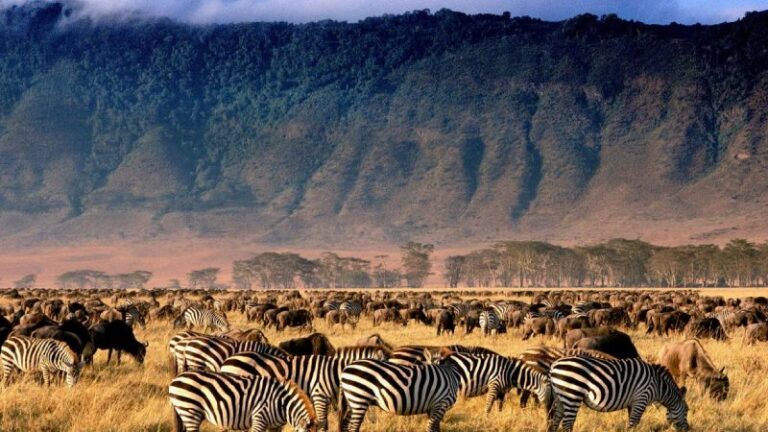
The Ngorongoro Crater, the world’s largest intact caldera, holds one of the densest concentrations of wildlife in Africa, including black rhino, lions, elephants and huge herds of zebra and wildebeest. The wider conservation area spans highland forest, savanna and the southern Serengeti plains, where Maasai pastoralists live alongside the wildlife. It was inscribed as a natural site in 1979 and became a mixed site in 2010, recognising Olduvai Gorge and the Laetoli footprints, which are about 3.6 million years old.
Type: Mixed (cultural and natural)
Inscribed: 1979, extended as a mixed site in 2010
Where: Arusha region, northern Tanzania, between Lake Manyara and the Serengeti
Getting there: By road from Arusha via Karatu, usually around three to four hours to the crater rim. Our Ngorongoro Crater excursion covers the game drive into the crater.
Best season: The crater is good all year. June to October is dry with easy game viewing, and from about December to March the migration herds calve on the plains of the southern conservation area.
Time needed: 1 full day for the crater, 2 days to add Olduvai Gorge or the highlands.
Official page: whc.unesco.org
Map: Show on Google Maps
🏛️ Ruins of Kilwa Kisiwani and Ruins of Songo Mnara
From the 13th to the 16th century, Kilwa was one of the great trading ports of the East African coast, dealing in gold, ivory, pearls, Persian pottery and Chinese porcelain. On two small islands you can walk through the Great Mosque, the palace of Husuni Kubwa, a Portuguese-era fort and the remains of stone houses and mosques at Songo Mnara. The site was on the List of World Heritage in Danger from 2004 to 2014 and was removed after conservation work.
Type: Cultural
Inscribed: 1981 (on the Danger List 2004 to 2014)
Where: Lindi region, on the southern coast near Kilwa Masoko
Getting there: By road from Dar es Salaam to Kilwa Masoko, a long day’s drive south, then a short boat ride to Kilwa Kisiwani and a longer one to Songo Mnara. Visitor permits are arranged locally in Kilwa Masoko.
Best season: The dry months from June to October. The long rains from about March to May make roads and boat trips harder.
Time needed: 2 to 3 days including the drive.
Official page: whc.unesco.org
Map: Show on Google Maps
🦁 Serengeti National Park
The Serengeti is the stage of the great migration, when well over a million wildebeest, zebras and gazelles move in a yearly circle between Tanzania and Kenya’s Maasai Mara, followed by lions, cheetahs and hyenas. Endless grass plains, granite kopjes and riverine forest make it one of the most famous parks on Earth. Our Serengeti travel guide explains the regions and where the herds are month by month.
Type: Natural
Inscribed: 1981
Where: Northern Tanzania, west of Ngorongoro, bordering Kenya
Getting there: By safari vehicle from Arusha through the Ngorongoro area, a full day’s drive, or by light aircraft to one of the park’s airstrips.
Best season: All year, depending on the region. The calving season in the south runs from about January to March, and river crossings in the north usually happen from July to October.
Time needed: 2 to 4 days.
Official page: whc.unesco.org
Map: Show on Google Maps
🐘 Selous Game Reserve
One of the largest protected areas in Africa, the Selous is a wilderness of rivers, lakes, woodland and grassland with elephants, hippos, crocodiles, African wild dogs and many other species. Most visitors today explore its northern part, which has been Nyerere National Park since 2019, by game drive and by boat on the Rufiji river. The site has been on the List of World Heritage in Danger since 2014, first because of elephant poaching, and UNESCO continues to monitor large development projects in the area.
Type: Natural
Inscribed: 1982 (on the Danger List since 2014)
Where: Southern Tanzania, south-west of Dar es Salaam
Getting there: By road from Dar es Salaam, by train or by light aircraft to the airstrips in Nyerere National Park.
Best season: The dry season from June to October. Many camps close during the long rains around April and May.
Time needed: 2 to 3 days.
Official page: whc.unesco.org
Map: Show on Google Maps
- Check out our tailored Tanzania tours, which we adapt to the parks and heritage sites you want to see.
🏔️ Kilimanjaro National Park
At 5,895 metres, Kilimanjaro is the highest mountain in Africa and the world’s highest free-standing mountain. Climbers pass through farmland, rainforest, heath and moorland and alpine desert before reaching the glaciers of Kibo. You do not have to reach the summit to enjoy it: day hikes on the lower slopes are possible too.
Type: Natural
Inscribed: 1987
Where: Kilimanjaro region, above Moshi, near the Kenyan border
Getting there: Fly to Kilimanjaro International Airport, then drive to Moshi and the park gates such as Marangu or Machame. See our guided Kilimanjaro trek from Moshi.
Best season: The drier months, roughly January to early March and June to October.
Time needed: 6 to 8 days for a summit climb, 1 day for a hike on the lower slopes.
Official page: whc.unesco.org
Map: Show on Google Maps
🕌 Stone Town of Zanzibar
Stone Town is one of the best preserved Swahili trading towns of East Africa. Its narrow lanes, carved wooden doors, coral-stone houses, mosques, churches and old forts reflect centuries of cultural exchange between Africa, Arabia, India and Europe. It is also a place of remembrance for the East African slave trade. Our local guide to things to do in Stone Town has walking ideas and tips.
Type: Cultural
Inscribed: 2000
Where: Zanzibar City, on the west coast of Unguja island
Getting there: By ferry from Dar es Salaam, about two hours, or by a short flight to Zanzibar airport, a few kilometres from town.
Best season: June to October and December to February are driest. Ramadan changes the rhythm of the town, so check the dates if you travel in that month.
Time needed: 1 to 2 days.
Official page: whc.unesco.org
Map: Show on Google Maps
🎨 Kondoa Rock-Art Sites
On the eastern slopes of the Masai escarpment, more than 150 rock shelters hold paintings made over at least two thousand years. They show people, animals and scenes that record the change from hunter-gatherer to farming and herding life, and some shelters are still used for rituals by local communities. The paintings around the village of Kolo are the most visited.
Type: Cultural
Inscribed: 2006
Where: Kondoa district, Dodoma region, central Tanzania
Getting there: By road from Dodoma or Arusha to Kondoa and Kolo, where local guides take you to the shelters on foot. Our Kondoa Rock Art Discovery trip includes transport and guiding.
Best season: The dry season from June to October, when the tracks to the shelters are easier.
Time needed: 1 to 2 days.
Official page: whc.unesco.org
Map: Show on Google Maps
UNESCO World Heritage Sites in Tanzania at a Glance
| # | World Heritage Site | Type | Inscribed | Where | Time needed |
|---|---|---|---|---|---|
| 1 | Ngorongoro Conservation Area | Mixed | 1979, mixed 2010 | Arusha region | 1–2 days |
| 2 | Ruins of Kilwa Kisiwani and Songo Mnara | Cultural | 1981 | Lindi region, south coast | 2–3 days |
| 3 | Serengeti National Park | Natural | 1981 | Northern Tanzania | 2–4 days |
| 4 | Selous Game Reserve (Nyerere National Park) | Natural | 1982 | Southern Tanzania | 2–3 days |
| 5 | Kilimanjaro National Park | Natural | 1987 | Kilimanjaro region | 1 day hike, 6–8 days climb |
| 6 | Stone Town of Zanzibar | Cultural | 2000 | Zanzibar | 1–2 days |
| 7 | Kondoa Rock-Art Sites | Cultural | 2006 | Dodoma region | 1–2 days |
Tanzania’s Tentative List
Countries put candidate sites on a Tentative List before nominating them. These Tanzanian sites are on the list but are not World Heritage Sites yet:
- Gombe National Park (1997): the chimpanzee forest on Lake Tanganyika made famous by Jane Goodall’s research.
- Jozani–Chwaka Bay Conservation Area (1997): Zanzibar’s forest and mangroves, home of the Zanzibar red colobus.
- Eastern Arc Mountains Forests of Tanzania (2006): ancient mountain forests such as the Usambara and Udzungwa ranges.
- The Central Slave and Ivory Trade Route (2006), Oldonyo Murwak (1997) and the Tendaguru Paleontological Site (2022).
- Geometric rock art in the Lake Victoria Region (2024): a joint candidate with Kenya and Uganda.
You can see the full list on the UNESCO page for Tanzania.
Frequently Asked Questions
How many UNESCO World Heritage Sites does Tanzania have?
Tanzania has seven World Heritage Sites: Ngorongoro, Kilwa Kisiwani and Songo Mnara, the Serengeti, the Selous, Kilimanjaro, Stone Town of Zanzibar and the Kondoa Rock-Art Sites.
Is Zanzibar a UNESCO World Heritage Site?
The historic Stone Town of Zanzibar is a World Heritage Site, not the whole island. The Jozani–Chwaka Bay forest on Zanzibar is on the Tentative List.
Which Tanzanian UNESCO sites can I combine on one safari?
Ngorongoro and the Serengeti sit next to each other on the northern circuit, and Kilimanjaro is close to Arusha and Moshi. Many travellers finish with a few days in Stone Town and on Zanzibar’s beaches.
Is the Selous Game Reserve the same as Nyerere National Park?
Nyerere National Park was created in 2019 from the northern part of the Selous. The World Heritage Site is still listed by UNESCO as the Selous Game Reserve.
Which Tanzanian UNESCO sites are in danger?
The Selous Game Reserve has been on the List of World Heritage in Danger since 2014. Kilwa Kisiwani and Songo Mnara were on it from 2004 to 2014 and Ngorongoro from 1984 to 1989.
When is the best time to visit Tanzania’s UNESCO sites?
June to October is the driest period and works for all seven sites. The northern parks are also rewarding from December to March during the calving season.
Plan Your Tanzania UNESCO Trip with TanzaniaAssist
Safari drivers, guides, park permits and lodges arranged by our local team, with fair prices and help every step of the way.
Browse Multi-Day Tours Explore Short Excursions